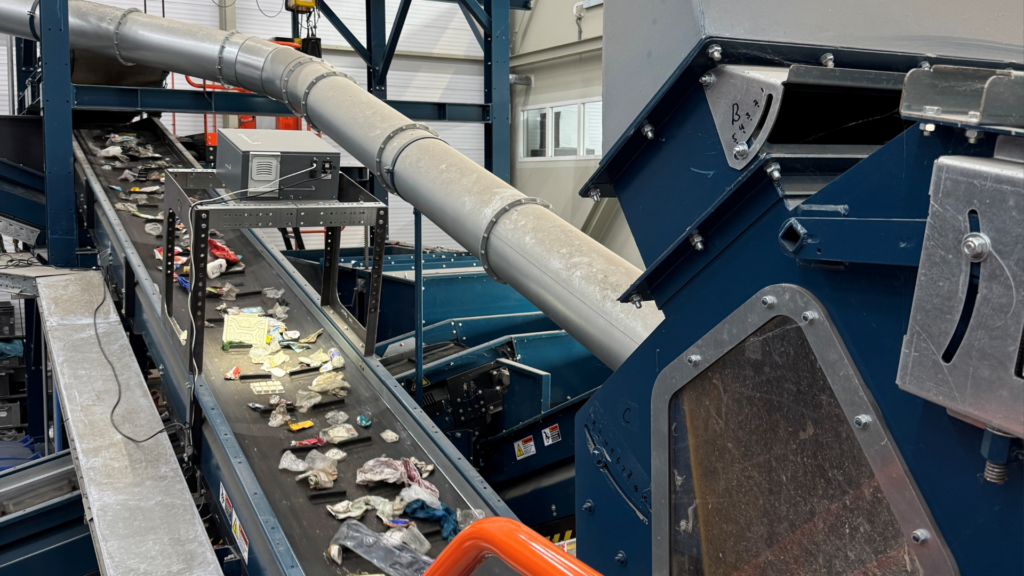
Ghent University, along with other partners of the Prosper Bioplastics Project, conducted a simulation of a European material recovery facility processing 75 kt/y of packaging waste, including PLA detection by NIR, putting long-standing assumptions under the microscope:
✅ PLA does not interfere with PET and PS recycling
Contamination in PS and PET streams remains negligible and below the reported maximum tolerance at the current PLA market penetration in packaging waste (0,12%), and even at higher PLA market penetration! This counters previous concerns that PLA could compromise material quality at recovery facilities.
📈 PLA bale’s purity improves rapidly with volume share
At 5% PLA share in the packaging waste stream, more than 90% of purity is reached.
And that’s based on conservative assumptions of PLA detection by NIR (88%), while actual performance can reach 99%: under standard conditions, the efficiency of PLA sorting will be even higher.
As a member of the consortium of Prosper Bioplastics, Futerro aims to demonstrate the technical and financial viability of recycling bio-based and biodegradable plastic packaging like PLA. Findings like these help us in the transition towards innovative, circular and bio-based solutions.
- Read the study: https://www.sciencedirect.com/science/article/pii/S0921344926000352
- Learn more on the bioplastics sorting model: https://youtu.be/cabwuGzcCKY?si=d9zpS_hs-XicN1hR
- More information on Prosper Bioplastics: https://prosperbioplastics.eu/
Wang, L., Schmuck, A., Van Caelenberg, L., Decottignies, V., Chang, H. B., Dupas, A., Ragaert, P., Gujar, S. A., van Eijk, M. C. P., & De Meester, S. (2026). Modelling material flows and cost-benefit of sorting PLA packaging waste in material recovery facilities under different market penetration scenarios. Resources, Conservation and Recycling, 228, 108811.