Climate change is reshaping European agriculture, and few sectors feel it as sharply as wine growing. Spring frosts, hail, excessive sun and heavy rain are no longer rare events: they are a recurring threat to both yield and quality. In a wine-producing continent like Europe, finding practical ways to protect vines and grape quality has become essential.
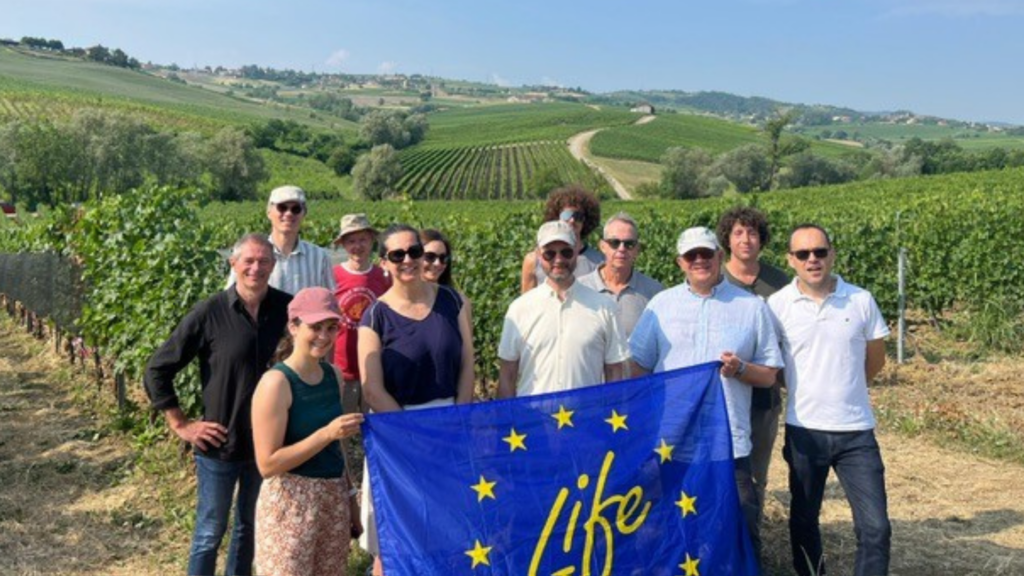
Late June in Piacenza, Italy, Futerro participated in the 3rd Steering Committee meeting of LIFE VINOSHIELD, a European project developing and testing protective nets to help vineyards across Europe adapt to the growing impacts of climate change. Discussions focused on the progress achieved so far, notably on tests on PLA hail nets.
A European answer to climate change in the vineyard
Backed by the European Union under its LIFE programme, VinoShield brings together a consortium of seven partners (Texinov, UCSC, Altavitis, Vinidea, INSA, IFV and Futerro) spanning viticulture, textile production, heat-transfer physics and bio-based materials across Belgium, France, Italy and Spain.
The VinoShield project focuses on the development and real-world validation of multifunctional textile protection systems, engineered to address a range of climate-induced challenges affecting vineyard productivity and quality.
Futerro’s dual role: supplying the PLA and closing the loop
Within this consortium, Futerro plays a dual role. We supply Futeon™ PLA used to manufacture some of the protective nets and anti-frost textiles, and we ensure those products can be recycled after use through our patented Loopla™ technology, which recovers the original monomer, lactic acid, to reproduce virgin-like PLA.
What we have achieved so far
From grade selection to first PLA hail net prototypes
The project began with the evaluation of several PLA grades to identify those best suited for agricultural net applications. This work enabled the production of the first PLA-based hail net prototypes, which are now being assessed and further optimised to meet the mechanical performance requirements of real vineyard conditions.
First field trials in the Bordeaux region
To evaluate their performance under real-world conditions, the first PLA hail net prototypes were deployed on a vineyard plot in the Bordeaux region, moving the solution out of the lab.
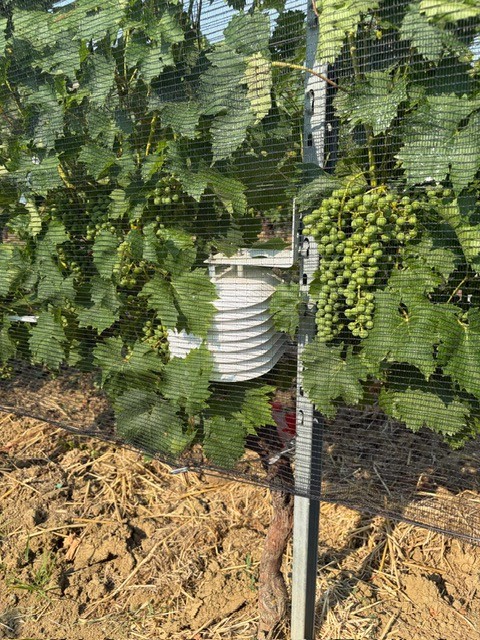
PLA-based hail nets under real-world conditions
Promising recycling results
Initial recycling trials were carried out on nets directly after production using Loopla™ technology. The tests demonstrated promising results, with high-quality monomer recovery and good yields, turning end-of-life agricultural textiles back into a feedstock for new, virgin-quality material.
The next steps
The next phase of the project will focus on improving the mechanical properties an of the nets based notably on feedback gathered from the ongoing field trials in the Bordeaux region.
At the same time, the project will assess the recyclability of nets after real-life exposure in vineyards. Building on the promising results obtained with production-stage nets, the partners will evaluate whether high-quality monomer recovery can also be achieved after the nets have been subjected to actual use and environmental conditions in the field.
Why this matters for plasticulture
Traditional fossil-based plastics have long boosted yields and protected crops. But their environmental legacy can also be a threat to soil health and long-term productivity.
The progress achieved in VinoShield so far confirms the strong potential of bio-based and biodegradable plastics in plasticulture, helping European agriculture move toward solutions that respect the environment and the land, while meeting the specific, real-world needs of the sector.
Materials like PLA offer a credible alternative. As shown on our Agriculture & Horticulture page, Futeon™ PLA can support protective nets, plant clips, bale nets and mulch films that are kinder to soil and ecosystems, without compromising on performance. Beyond its recyclability, Futeon™ PLA can also be blended for tailored degradation profiles depending on crop cycles and climate.
Want to explore how Futeon™ PLA could support your agricultural applications?
The LIFE Program is the EU Program for Environment and Climate Action. The VINOSHIELD project is part of the “Climate Change Mitigation and Adaptation” sub-program within the LIFE Program, contributing to the European Green Deal’s objectives.